
A bank’s assets and liabilities never line up neatly. Loans and deposits reprice on different schedules, mature at different times, and shift as customers borrow, repay, and move money. That mismatch is where interest rate risk in the banking book lives, and managing it is a daily job: Treasury and Asset Liability Management (ALM) teams work the net position across the whole balance sheet, adjusting as it moves.
The accounting framework, however, was not built for that reality. Today’s hedge accounting was developed around stable relationships between individual exposures and individual hedging instruments. Modern balance sheets do not behave that way. They are constantly changing. This is why the International Accounting Standards Board (IASB) has proposed the Risk Mitigation Accounting (RMA) model to replace the hedge accounting model. At its core, the proposal asks a simple question: should accounting reflect how banks actually manage interest rate risk?
ALM Partners works inside bank risk and reporting functions across the Nordics and Europe. That means we look at a proposal like this from the same angle as our clients: what it will mean in practice, not just what it says on paper.
This is our first article on Risk Mitigation Accounting, and it focuses on answering the following question: what problem is RMA trying to solve?
What is Risk Mitigation Accounting?
Risk Mitigation Accounting is a proposed accounting model developed by the IASB for banks that manage interest rate risk across dynamic portfolios. Unlike today’s hedge accounting, which often focuses on individual hedging relationships, RMA is designed around the way Treasury and ALM teams already manage risk across the balance sheet. Risk management stays exactly as it is; what changes is that financial reporting gets to reflect it properly.
Why today’s hedge accounting does not always fit the way banks work
A bank’s balance sheet never stops moving. New mortgages are issued, existing loans are repaid, customers refinance, and deposits increase, decrease, and move between products. None of this is exceptional; it’s the normal rhythm of banking. The risk gets managed across the balance sheet as a whole, not one position at a time.
Current hedge accounting was not originally designed around that reality. Instead, it often asks banks to represent dynamic risk management through stable hedging relationships.
This creates an uncomfortable situation. Much of that machinery exists mainly to satisfy the rulebook, largely disconnected from how ALM teams actually manage repricing risk day to day. The real risk management happens on the net position; the hedge accounting is a construct layered on top to make that activity presentable in the financial statements. Sometimes the construct even starts to influence the hedging itself, rather than simply reflecting it. That inversion, where accounting shapes risk management instead of following it, is the gap Risk Mitigation Accounting is trying to close.
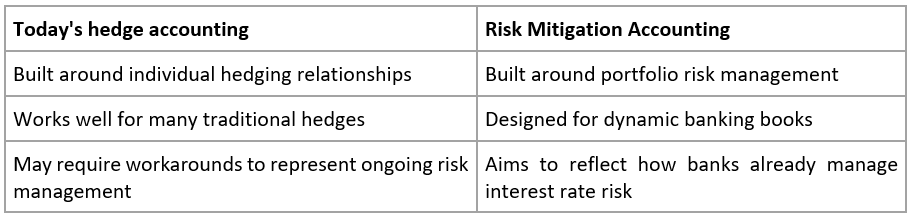
Think of it this way: today’s hedge accounting often feels like taking snapshots of something that is constantly moving. Risk Mitigation Accounting aims to follow the film instead.
How does Risk Mitigation Accounting change the picture?
If the challenge is accurately representing dynamic balance sheet management, the obvious next question is what changes under the proposed model. The biggest change is not in how banks manage risk. They would continue doing that exactly as they do today. The change is in the accounting. Rather than starting from individual hedging relationships, the proposed model would start from the net interest rate position that Treasury and ALM teams already manage. This would bring financial reporting closer to the bank’s existing risk management activities.
The proposal introduces new concepts, calculations, and documentation requirements. We will explore those topics in later articles. For now, the important point is much simpler: the proposal is aimed at reducing the gap between operational reality and financial reporting.
Treasury teams do not wake up thinking about accounting models. They think about managing interest rate risk while supporting the business. RMA matters because it seeks to reduce the distance between those day-to-day decisions and how they are reflected in financial reporting.
The standard setters generally view the benefits of the model as largely established. These include:
- Better comparability between banks
- Closer alignment between accounting and risk management
- More transparency for investors into activities that can often be difficult to understand from the outside
The open question is the cost involved, both to implement and to run year after year.
Who should be paying attention?
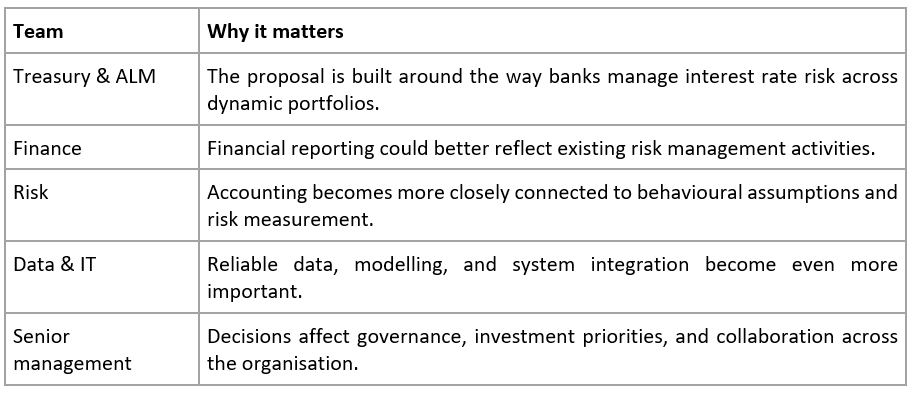
Although the word “accounting” appears in the term Risk Mitigation Accounting, this conversation should not stay solely within the Finance function. It often starts with a different question: does our financial reporting reflect the way we already manage interest rate risk? From there, the discussion naturally expands.
Is Risk Mitigation Accounting really optional?
Banks report under International Financial Reporting Standard 9 (IFRS 9) today, while the older IAS 39 standard has largely been discontinued. However, many European banks still use the IAS 39 EU carve-out option for portfolio hedge accounting within IFRS 9, and this proposal would withdraw this option. So the honest question is not “should we implement RMA or not?” A bank that declines RMA still moves to IFRS 9’s general model, so the real choice is which path through IFRS 9 you take.
Plenty of banks in Europe still apply the carve-out today, not because they prefer it, but because a full transition to IFRS 9 hedge accounting was never budgeted while the carve-out kept working. For those banks, the withdrawal turns a long-deferred decision into an unavoidable one. There is also a specific trap on the way out: a bank that declines RMA and moves to plain IFRS 9 may find that a hedge that worked under the carve-out qualifies under neither model. This is because IFRS 9’s general model is built for one-to-one hedging relationships, not the dynamic portfolio hedging a carve-out user relies on.
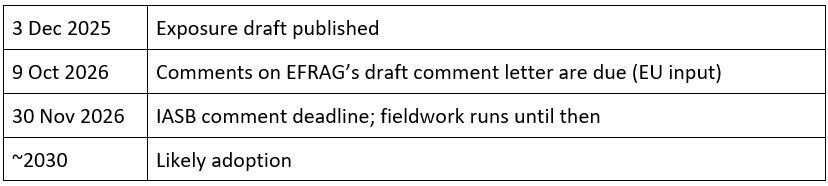
That does not mean implementation decisions need to be made today. It does mean, however, that the calendar is quieter than it looks. Right now, the proposal is in its consultation phase: the IASB has published the draft and is inviting banks, regulators, and other stakeholders to comment on it and to test it against real balance sheets before anything is finalised. This is the one window in which banks can still shape the model, rather than simply receiving it.
For EU banks, there are two ways in, and both fall this autumn. They can help shape Europe’s collective response by commenting on the draft position drawn up by the European Financial Reporting Advisory Group (EFRAG) by 9 October 2026. They can also comment directly to the IASB on the proposal itself by 30 November 2026. A bank that wants the final standard to fit its balance sheet is better served speaking now than reading the result later.
RMA Timeline
Questions banks can already start asking
No adoption decision is needed to begin the conversation. Some useful questions include:
- Does our current hedge accounting reflect how we actually manage interest rate risk?
- Which parts of our balance sheet are hardest to represent today?
- What currently relies on the IAS 39 carve-out, and what would happen if that approach changed?
- Which teams would need to work together if we explored Risk Mitigation Accounting?
- Do we already have the data, governance, and behavioural models that such an approach would require?
These are some of the questions we are working through with banks right now, and the answers look different in every institution. If you are starting to map the questions for your own balance sheet, ALM Partners is happy to help.
Q&A: Risk Mitigation Accounting at a glance
1. What is Risk Mitigation Accounting?
Risk Mitigation Accounting is a proposed IFRS 9 accounting model designed for banks managing interest rate risk across dynamic portfolios rather than individual hedging relationships.
2. Why was RMA proposed?
RMA was proposed because today’s hedge accounting does not always reflect the way Treasury and ALM teams manage interest rate risk across changing balance sheets. Current accounting is largely built around stable, individual hedging relationships, while Treasury and ALM teams manage risk across dynamic portfolios. RMA aims to bring accounting closer to operational reality.
3. Is RMA mandatory?
No. RMA itself is optional, but the withdrawal of the IAS 39 carve-out used by many European banks within IFRS 9 is not. Those banks will need a new home for the portfolio hedging activities currently accommodated by the carve-out, whether or not they adopt RMA.
4. Who should pay attention?
Treasury & ALM, Finance, Risk, Data & IT, and senior management.